
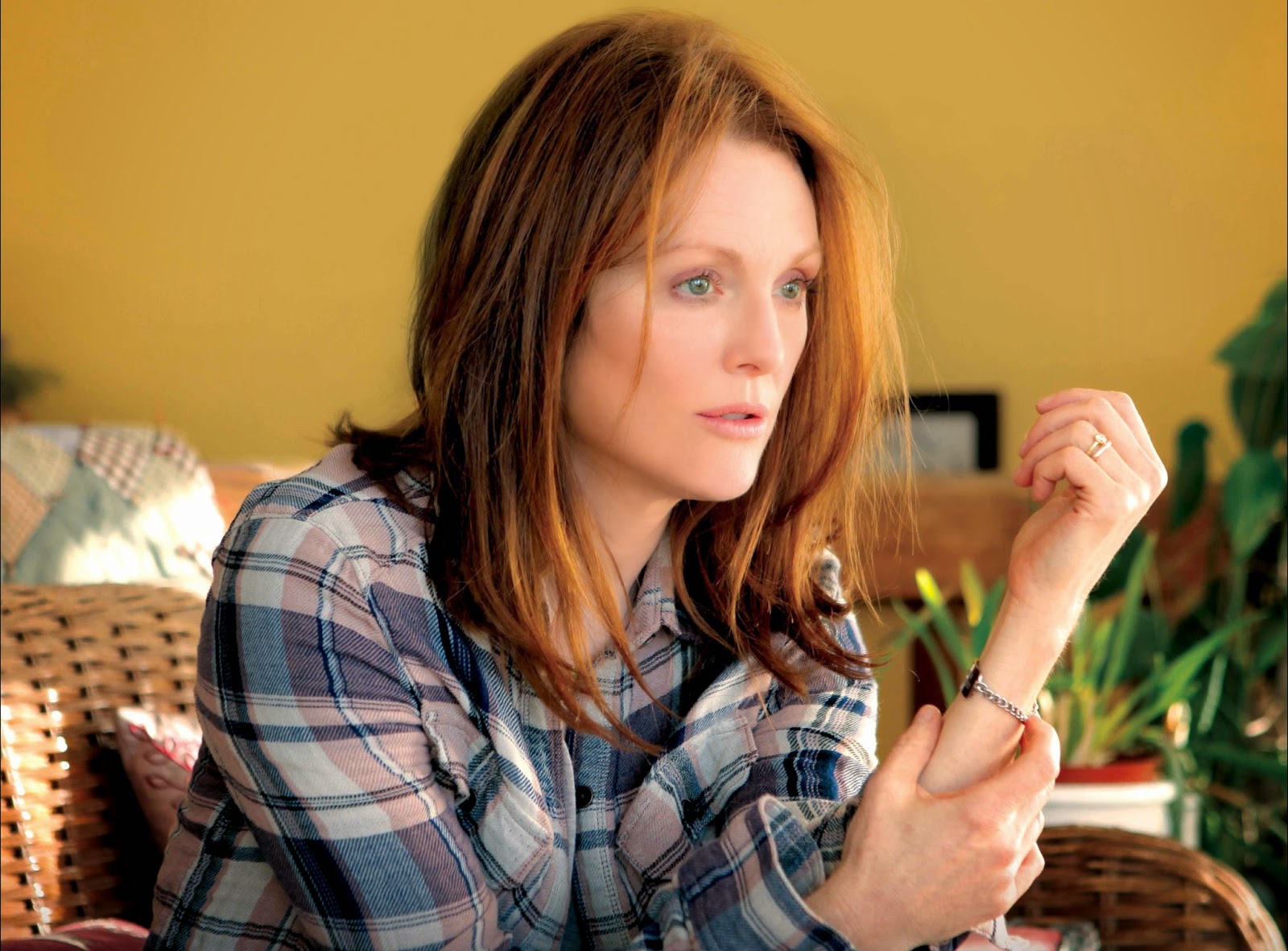
 Without Julianne Moore, “Still Alice” might not be much of a film. This is not to say the adaptation of Lisa Genova’s 2007 novel about a 50-year-old woman with early-onset Alzheimer’s disease is otherwise mediocre, although it is so unobtrusively constructed that its virtues may be overlooked. But because it focuses on the perspective of a person with Alzheimer’s rather than on that of her caregivers, a uniquely gifted actor is required in the titular role. Who but Moore, with her radiant fusion of fortitude and empathy, could soldier us through a narrative whose unhappy ending is as inevitable as that of the Titanic?
Initially, Alice Howland seems like she has it all. A celebrated Columbia University linguistics professor, she is happily married to fellow academic John (an unusually muted Alec Baldwin), with whom she has three grown children and a well-appointed Long Island beach house and NYC brownstone. If she is a tad thorny when things don’t go her way–her youngest daughter, Lydia (Kristen Stewart), an aspiring actor, bears the brunt of her mother’s tenacity–it’s par for the course in a modern Type A woman. But when Alice can no longer write off her memory loss and growing confusion as menopause side effects, her worst fears are outstripped. She is diagnosed with a rare strain of inheritable Alzheimer’s. “I wish I had cancer,” she weeps, and although some might take umbrage with her disease comparison-shopping, we understand what she means. Especially in her line of work, she does not know who she will be without her formidable brain.
Though this narrative is unwaveringly linear, we are quickly discombobulated. The film’s progression mirrors Alice’s decline so fastidiously that time dissolve for us as it does for her, all rituals and goals to which she clings decomposing with a devastating efficiency. Daily runs quickly become impossible. Regular appointments are forgotten, then the layout of her house. One afternoon, she soils herself before she can find the bathroom. Each time Alice, ingenious at her core, devises a workaround for a new set of limitations, the ground beneath her feet crumbles further. We live right inside her growing panic and sorrow, the film’s initially clean lines growing fuzzy as her visual comprehension deteriorates.
Because of Alice’s high intelligence, her Alzheimer’s went undiagnosed longer than it would have had she possessed fewer compensatory intellectual resources. The irony, of course, is that she and her family possess very few compensatory resources once her rapid degeneration is evident; as cerebral people, they are especially ill-equipped to cope with her ever-increasing mental challenges. John, in particular, proves disappointing. “You are the smartest woman I know,” he tells her early on, and when their shared values of independence and intelligence become nonstarters, we learn that objectifying a woman for her brain is as problematic as objectifying her for her beauty. Marriage on any contingency plan is precarious.
It can be argued that “Still Alice” is too Lifetime-for-TV neat; that its secondary characters are too two-dimensional. While I’d never claim this film is avant-garde, I admire directors and screenwriters Richard Glatzer and Wash Westmoreland’s resistance to “fake stakes,” the peaks and valleys that normally shape a cinematic narrative. The hurdles that Alice clears – how she successfully collects herself after initially fumbling a speech; a suicide attempt – only deepen our growing acceptance that there is no way to subvert her ultimate obstacle. Similarly, it tracks that Alice’s family and friends don’t feel quite real long before she actually forgets their names. Her ability to distinguish personality nuance is compromised, and we’re there with her. Of course, this doesn’t excuse everything. A linguistics professor who is losing words is a tad on the nose, as is the discovery of Alice’s genetic disorder just as her eldest daughter (Kate Bosworth) undergoes fertility treatments.
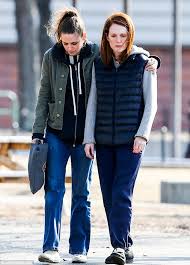 What works beyond a shadow of a doubt is Moore herself. For a long time now, she has demonstrated an uncanny range and power without ever subjecting us to a shred of vanity. Here, she outdoes herself, channeling Alice’s physical, mental, and emotional devolution with an alchemy both thrilling and harrowing. Her luminous features slacken, her cadences falter, her life force fades. Scenes with Stewart prove especially heartbreaking. After all that mucking about with vampires, the younger actor is finally returning to form, and the careful attentiveness she shows her mother highlights the one hopeful note we are sent. Love never leaves.
This review was originally published in Word and Film.