
Archive | City Matters
‘It’s a Sin’: AIDS as Generation Black Hole
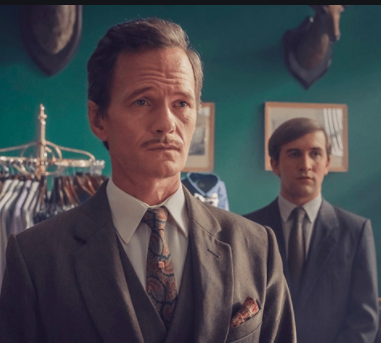
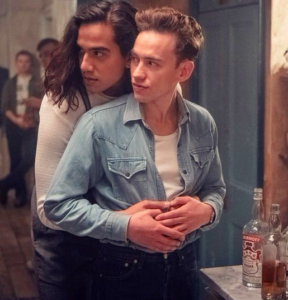 I inhaled the HBO Max/Channel 4 AIDS dramatic mini-series It’s a Sin in one day and am still thinking about it.

As someone who was in ACT UP and moved to the West Village in the early 90s, AIDS is never off my radar. I’ll never forget my beautiful young friends who seemed like ghosts even before they died. I’ll never forget equating sex with death even before I lost my virginity.
The London-set series has charisma to spare–hip-strutting, head-strong boys; head-spinning montages; spot-on 80s and 90s set and costume design; catchphrases! But it spares no soundtrack cliches nor no 90s-era micro-aggression: witness its centralization of white characters; the lack of sex life for the sole female protagonist, who seems to exist solely to caretake men.
I resist the critique that It’s a Sin fast-forwards too quickly, though. While I was still in my teens, the transition from carefree club life and wanton fucking to hospitals, funerals, and activism took place in the blink of an eye. Gender/sexual harassment/trauma was so widespread it was background noise–something you white-knuckled through if you wanted an apartment, job, not to get beat to a pulp. Believe me. As someone who has often called out aberrant behavior—who confronted the landlord who stuck his tongue down my throat, who refused to work for the newspaper editor who licked his lips while asking if I had a boyfriend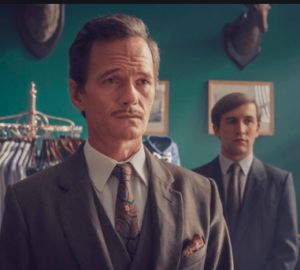 –my career and livelihood suffered mightily.
Gen X is too hard on Z/millennials, but we resent younger people’s assumption that we’re oblivious to trauma. My generation of queers just was swamped with too much macro-aggression–mass extinction and existential horror–to tackle micro. Oh how this show captures that giddy ghastly time.
Beginning of End Times
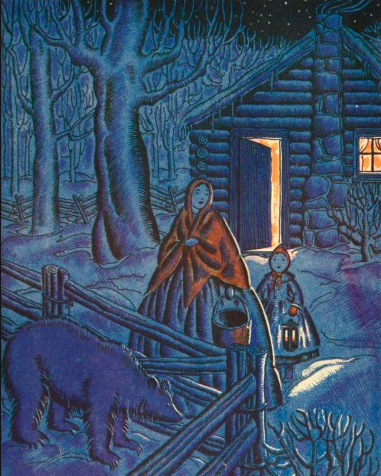
“The Night Was Quite Dark,” Helen Sewell
It’s 740pm and I’m calling it. The electricity went out in the early hours of this morning after the big storm, and it never got fixed so my apartment is unheated unlit un-networked. A part of me–the part that obsessively reread Little House in the Big Woods (and not just as a child)–appreciates the challenge of being stripped of power. Of laying blankets over everything and setting up candles and heating water over my stove, which still works with a match. But as night has fallen, an unaccustomed darkness has blanketed my neighborhood and it is eerily silent. The outage stems from a manhole fire four blocks over and so my entire region of East Williamsburg is un-juiced. It’s like the 2003 blackout or the 2012 hurricane–only for my tiny little corner of Brooklyn. There’s no coffee shop noise, no infuriating neighbor music or loud Zoom calls hurtling through the walls. No blather on the street. No streetlights. Not even any running cars since they’ve blocked off the streets (and there are no traffic lights). There’s just the drills of Con Ed guys outside my window, grinding grinding like gritted teeth.
I know these guys are trying their best–have been since before dawn–and that so far they simply can’t locate the electrical short to fix. I know because I brought them mugs of my Laura Ingalls Wilder coffee earlier and peppered them with questions. So it’s like camping—only in a subfreezing night in which Covid keeps us from cowering together.
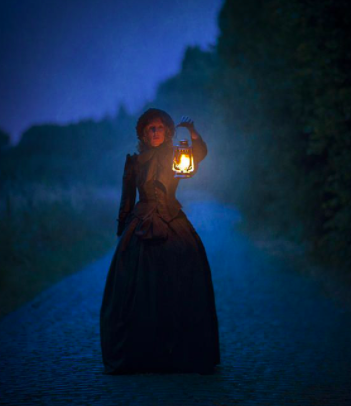
“Woman in the Dark,” Anonymous
I keep thinking about what this corner of land was like 10 years ago, 100 years ago, 1000 years ago. I keep thinking about that last chapter of Cloud Atlas, when the grid and governments crashed and everyone in the future was living prehistorically and no one had record of prior generations because they had been uploaded to the cloud which disappeared with the electrical grid. And I keep thinking: Is this how dystopias really happen? Step by step, so that we adjust so incrementally to the degeneration that one day it seems perfectly natural that we can’t leave our houses without masks lest we infect each other with a deadly plague that has already killed 500,000 of us, perfectly natural that we’re stumbling around in the unheated unlit un-networked dark, perfectly natural that hot regions are freezing and polar caps are melting, perfectly natural that there’s mass shootings every month, perfectly natural that we have elected officials who casually uphold white patriarchal supremacy and insist Jews use space lasers to fuck up a coastal state and . Don’t answer that. Really, don’t. I know I’m being catastrophic but it’s been that kind of day week (retrograde). The point is: There’s a fur hat on my head, a fur blanket on my bed, a fur permakitten in my arms. And I’m going to bed. Scarlet O’Hara always said I”ll worry about it tomorrow. Tonight I’m taking a page from her book.
Note: My power was out for 48 hours. When it came back on, I posted what I’d written to comfort myself.