
‘Palo Alto’: How the Coppola Dynasty Thrives
 The following is a review I originally published in Word and Film.
Much has been made of James Franco’s unfortunate Instagram flirtation with an underage Scottish girl last month, especially as it dovetails with the release of “Palo Alto,” in which he plays a high school soccer coach who has a sexual relationship with a student. Was his transgression a publicity stunt for the film, one of his bizarre meta-performance art pieces, or the flailing of another predatory adult male who’s failed to grasp that privacy is, like, so last millennium?
No matter what the actor/PhD candidate/writer/director/artist/Seth Rogen aficionado’s intentions, it’s hard not to flash on Instagram-Gate when first settling in to watch Gia Coppola’s film about the dissolute adolescents in a California suburb. In one of its first images, we’re introduced to Franco as “Mr. B,” a figure looming against a soccer field backdrop. Here, his sparkly eyes are a little dimmer; his once-lithe build a little bulkier; his overall visage a lot more dissipated. In short, he resembles the kind of fellow keen to recapture his glory days at whatever cost necessary.
It’s also hard not to flash on Franco as Daniel Desario from “Freaks and Geeks.” Not since Matthew Broderick, who played that iconic delinquent Ferris Bueller, appeared as a hapless civics teacher in “Election” has an actor’s transition from student to teacher roles so succinctly signaled the passage of a generation.
In general, “Palo Alto” is all about the passing of torches. First-time director Coppola bears quite the pedigree: Her great-grandfather is film composer Carmine Coppola; her grandfather is director Francis Ford Coppola; her aunt is director Sofia Coppola; her cousins include actors Nicolas Cage and Jason Schwartzman; and she most resembles her great-aunt, actress Talia Shire. Gia’s film features Julia Roberts’ niece and Eric Roberts’s daughter Emma Roberts as April, the soccer player involved with Mr B; the son of Polly Draper from “Thirtysomething,” Nat Wolff, is Fred, a whirling dervish of destructive testosterone; and Val Kilmer’s son Jack Kilmer is Teddy, an artist calamitously influenced by his best friend Fred. (Val also appears in this film as April’s ponytail-sporting father, who so aggressively proofs her papers that she’s accused of plagiarism.) To Coppola’s credit (for the sake of clarification, “Coppola” will refer to Gia for the duration of this review), for her first directorial effort she tackles the queasiness of legacies head-on, and without the pretty, “poor-little-rich-girl” torpor that is her aunt’s trademark. Continue Reading →
Of Heels and Men (Or: Heels and Heels)
 Though it’s commonly believed that women wear high heels to attract men, my boyfriends have never liked me wearing them. I’m a moderately tall woman with unapologetic posture—none of that stooping or pigeon-toeing you find in many ladies of a certain height. Chalk it up to my stint as a yogi, as well as the fact that I am the shortest woman in my family. Keep in mind that I am still taller than my dad; in the Rosman clan, a penis doesn’t necessarily grant you physical dominance.
Maybe it was a desire to get as far as possible from my father that led me to date improbably tall men when I was younger. Six foot two, six foot four. One boyfriend–a German, no less–was six foot six. But I also think some of us are just wired for tall men, as if their height genetically signals good bones, good brains, good odds. Not to mention that it’s hard to resist a fellow who can swing you over his shoulders.
In my early 30s I began a serious relationship with a man poised to become a huge success. Only a few inches taller than me, this man was not only shorter than my typical suitors but was generally physically unprepossessing. Nerdy, even. I ended our relationship for a reason I still do not regret despite the legendary Internet company he launched soon after our breakup: though I appreciated his mind, work ethic, and self-confidence, I couldn’t bear the prospect of only sleeping with him for the rest of my life. As he barely acknowledged that he even had a body, it would have been a patently unfair arrangement. Continue Reading →
‘God’s Pocket’: Philip Seymour Hoffman, Posthumously
 The following is a review I originally published in Word and Film:
When an artist as talented as Philip Seymour Hoffman dies unexpectedly, a cultural void develops in their absence. It’s not just that we can’t accept the loss; it’s that we can’t entirely register it. In some childlike recess of our minds we keep seeking an alternative reality in which they are writing another book, recording another song, shooting another film. Elisabeth Kübler-Ross may have identified this as the bargaining stage of grief and loss but I think it’s more complicated than that.
Unless we knew the artist personally, for us they only existed in a communion between their imagination and ours, anyway – an interstice of consciousnesses outside of life and death. Even after they die, then, we continue to visit their work for that connection. And if it’s an artist as prolific as Hoffman, for a while their posthumous work grants us additional destinations, which is when the bargaining does creep in. We study this new work not only for insights into their sudden death but for evidence of an alternate reality – a reality in which the person is still alive and still creating more worlds that we may visit.
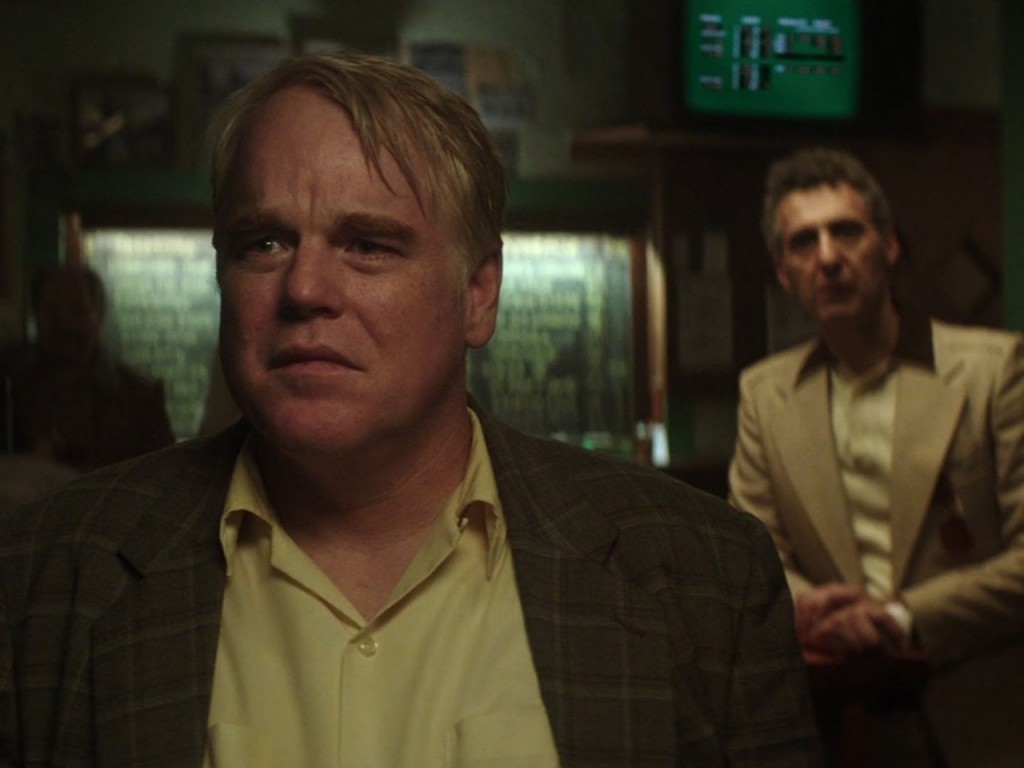
Which is to say that it’s both difficult and enthralling to watch “God’s Pocket,” a sad sack of an indie directed by Mad Men‘s John Slattery that features Hoffman in one of his last performances. The movie itself is a mixed bag. Set in a fictional working-class section of South Philadelphia named, unfortunately enough, God’s Pocket, it is populated by underdogs who have so little to boast about that they uphold their neighborhood with a blind patriotism that renders non-natives inferior in their eyes. The result is that the neighborhood itself is this film’s true protagonist, with Hoffman as Mickey, a hard-drinking, low-level criminal, running a distant second. Continue Reading →