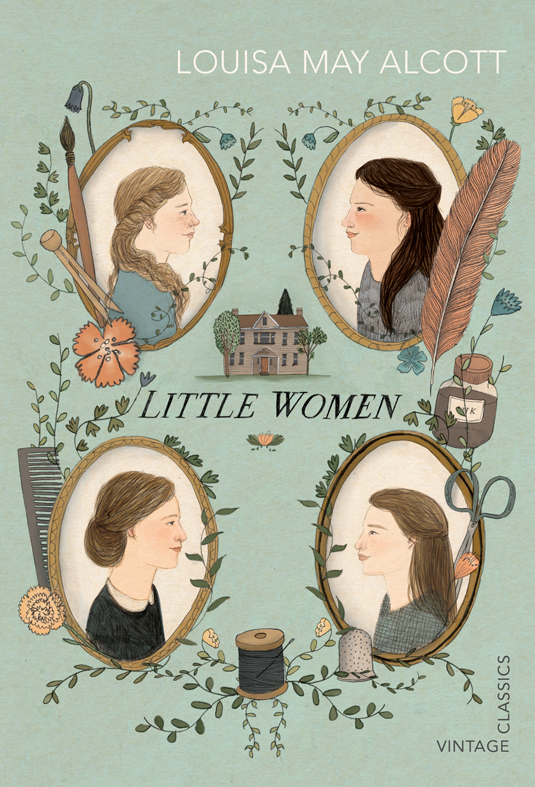
 To know Little Women is to love Little Women. From its very first line – “Christmas won’t be Christmas without any presents” – Louisa May Alcott’s landmark 1868 novel about four cash-poor, rich-in-spirit sisters has captured generation after generation’s love and devotion. The book’ got it all: cozy escapades, romantic triangles, “operatic tragedies,” and delicious descriptions of puddings, velvet gloves, and those infernal pickled limes. There’s pretty, maternal Meg. Artistic, vain Amy. Shy, musical “Poor Beth.” And Jo, the strapping, temperamental tomboy who aspires to be a writer when she grows up.
Just like everyone is a Charlotte, Samantha, Carrie, or Miranda today, everyone was once a Meg, Amy, Beth, or Jo. I suspect everyone secretly loved the slapdash Jo most; there’s a reason Kate Hepburn played her in the film adaptation.
As an aspiring writer in elementary school, I adored all the sisters and clamored for the “Pilgrims Progress” morals that Alcott, a true daughter of the Transcendentalists, sewed into their scrapes and graces. But the book most came alive when Jo galloped to the forefront. Loyal to a fault, indifferent to the domestic arts, and giving no fig for her appearance, she wrote volumes while decked out in the “scribbling suit” that prompted her family to ask, “Does genius burn, Jo?” As her sisters married or passed away, Jo clung to her dream of becoming a lady author, submitting her work for prizes and publication and even moving to New York City from Massachusetts to make a real go of it.
But as many times as I pored over the book, I usually stopped reading before its very end. It wasn’t because spoiled Amy won Laurie’s love and baubles after Jo spurned his affections. It wasn’t because of Beth’s sorry decline. It was because Jo married Mr. Bhaer, the German scholar who dismissed her writing out of hand. Although the first half of Little Women (the good part, I always thought) comprises a book composed by Jo in the second half, she lays aside her writing to become his wife and the mother of two boys.
This killed me, and I don’t think I’m the only one who felt that way. I was hungry for bildungsromans about budding female writers, and the taming of Jo March dashed my dreams. It seemed so odd that her fate was portrayed as a happy ending. I viewed Beth’s death as less grim. Continue Reading →