
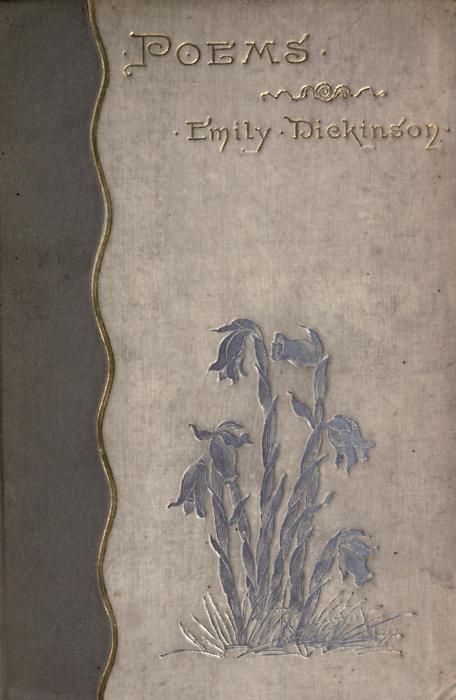
 Her story has become as iconic as that of Vincent Van Gogh and his cut-off ear. She was the Belle of Amherst, the woman in white who locked herself away in the family attic, scribbling sheaves of poems that were never published until she passed from this earth. She was, of course, Emily Dickinson, and if anything, she thrives more today than she ever did while alive. Volumes have been generated about her volumes, and this year alone she was the subject of the Terence Davies biopic, “A Quiet Passion,” and of the exhibition “I’m Nobody! Who are you? The Life and Poetry of Emily Dickinson” at New York’s Morgan Library and Museum. Her lines – breathless, flashing, and eminently em-dashed – are quoted with an unflagging regularity, and she’s upheld by feminist scholars and modernists alike as a godmother of sorts. (She was never the type to be a grandmother.) Continue Reading →
Archive | Feminist Matters
The Fast Company of Eve Babitz
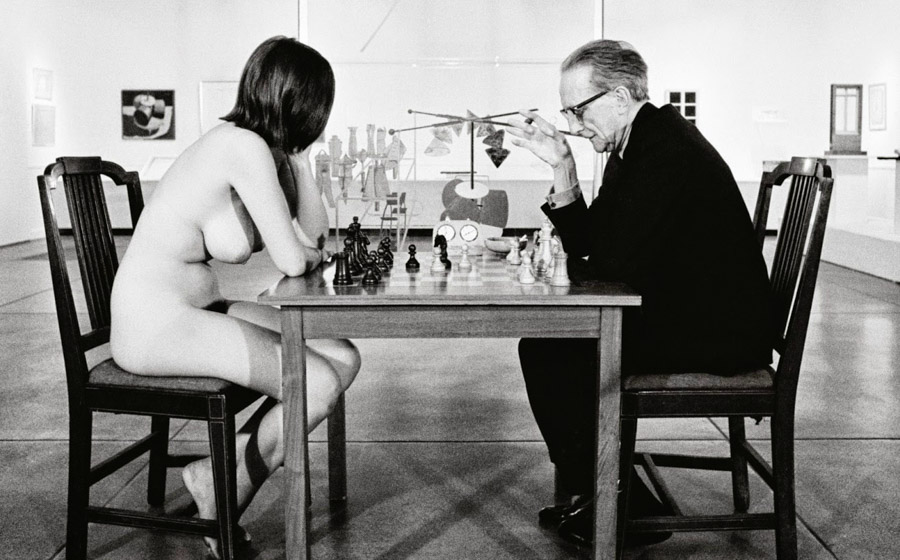 There were many West Coast It Girls of the 60s and 70s, but Eve Babitz may have been the West Coast It Girl, at least among people in the know. Born in 1943 to a Jewish studio violinist and a shiksa Texan rose, Igor Stravinsky was her godfather and Greta Garbo, Charlie Chaplin, and Bertrand Russell her family friends. In the 1960s, she became a “groupie-adventuress” who designed album covers for Linda Ronstadt and Buffalo Springfield, befriended everyone from Frank Zappa to Salvador Dali, and counted Steve Martin, Jim Morrison, Harrison Ford, Annie Lebowitz, and both Ruscha brothers (photographer Paul and painter Ed) among her many lovers. She also was the nude girl in that famous photograph of Marcel DuChamp playing chess. You know the one.
Also she was an extra in Godfather II because she was sleeping with the film’s casting director and, well–why not?
None of these biographical details are as compelling as Eve’s prose. In essay collections and autobiographical novels, she rhapsodized about booze, beauty, jacarandas, and, above all else, her native stomping grounds of Southern California. Whether the subject was the many sorts of SoCal winds or a perfect crate of Chavez-approved grapes, she wrote with such extravagance that you found yourself falling in love with Los Angeles even if you’d always considered it a cultural wasteland–an opinion that would have rendered you a cultural wasteland to Evie, were you dim enough to express it around her. Continue Reading →
‘Radical Hope’ with Carolina de Robertis (Q&A)
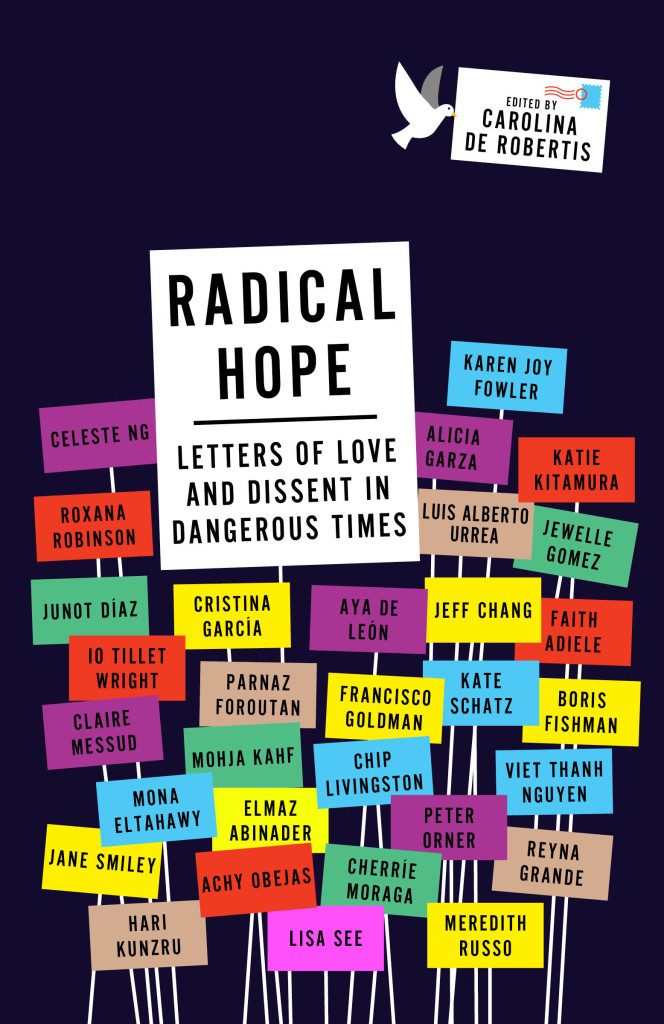 An award-winning novelist and literary translator, Carolina de Robertis has donned a new hat for her latest literary effort, that of anthology editor. In the wake of the November 2016 U.S. presidential election, she put out a call for politically inflected love letters in the tradition of James Baldwin’s 1963 The Fire Next Time essay, “My Dungeon Shook: A Letter to My Nephew.” The result is Radical Hope, a series of epistolary essays that are bound to shore progressives in the months and years to come. We discussed this remarkable collection with de Robertis, who lives in San Francisco with her wife and children.
LISA ROSMAN: Let’s start with nuts and bolts. Is this book merely a response to the election of Donald Trump?
CAROLINA DE ROBERTIS: It’s not just about the election of Trump because I think it’s important to extend our gaze to something larger and deeper in our country, though he as an individual is certainly his own kettle of dangerous fish.
The idea came to me three days after the election. I was sitting at my writing desk unable to work on my own novel, and I was thinking about how writers might be able to respond and contribute to the dissent and resistance that was going to be necessary in the coming social and political climate. I have a big photograph of Baldwin hanging over my writing desk and I couldn’t stop thinking about that essay in which he addresses his nephew. It seemed to me that his form of letter-essay was particularly helpful for blending personal reflections with sweeping political analysis, a blend we very much need in these times. Continue Reading →